01 August 2021

Books: Black Buck By Mateo Askaripour (2021)


"An unambitious twenty-two-year-old, Darren lives in a Bed-Stuy brownstone with his mother, who wants nothing more than to see him live up to his potential as the valedictorian of Bronx Science. But Darren is content working at Starbucks in the lobby of a Midtown office building, hanging out with his girlfriend, Soraya, and eating his mother’s home-cooked meals. All that changes when a chance encounter with Rhett Daniels, the silver-tongued CEO of Sumwun, NYC’s hottest tech startup, results in an exclusive invitation for Darren to join an elite sales team on the thirty-sixth floor. After enduring a “hell week” of training, Darren, the only Black person in the company, reimagines himself as “Buck,” a ruthless salesman unrecognizable to his friends and family. But when things turn tragic at home and Buck feels he’s hit rock bottom, he begins to hatch a plan to help young people of color infiltrate America’s sales force, setting off a chain of events that forever changes the game"

Much of Black Buck is stylish, satirical take on the persistence of racism within corporate America. It’s also an updated version of Glengarry Glen Ross, with folks like Rhett and Clyde taking on the role of the Alec Baldwin character from that film. Askaripour’s Darren/Buck litters his book with Stephen Covey and Dale Carnegie style quotes on how to be a salesperson (Sales isn’t about talent, it’s about overcoming obstacles, beginning with yourself.), but adds to them as well:

Reader: If you are a black man, the key to any white person’s heart is the ability to shuck, jive, or freestyle. But use it wisely and sparingly. Otherwise you’re liable to turn into Steve Harvey.

The books message is obvious, and is seemly designed to make anyone a non-POC cringe with some of the more absurd aspects. I know it takes a certain person to be able sell stuff no one really wants, and the I know some companies, some people within those companies believe the only way to make a great salesperson is to break them down, humiliate them, and drive them to the brink of quitting, before building them back up, but the things that happen here are sometimes a bit too much to believe. I’m not sure if any company can do what happens in these pages; the sort of company sanctioned racism and hates crimes, and get away with it. But reading a tale about a Black man willing to sell his soul to the White man and not only realize what he’s doing, but accepting it makes Darren a bit disingenuous.

Still, the supporting characters are fine, if not trope filled (Jason was the worst). And I did get a bit weary of that everyone thinking he was the Messiah of the neighborhood –the one and only Black man who was going to make it.  The Chosen One.

Much of the second half falls apart, as Askaripour seemly takes on too much story and ends up tossing out a lot of what made the first half so scary good. The message about racism, microaggressions and cultural appropriation is really never fully addressed and the theme “each one, teaches one", while a fantastic idea, sort of devolves, and falls away in those final chapters.

It’s still a great, dark satire, but Askaripour really never gives us a clear direction on how to solve the racism and lack of diversity within the upper echelons of corporate America.

27 July 2021

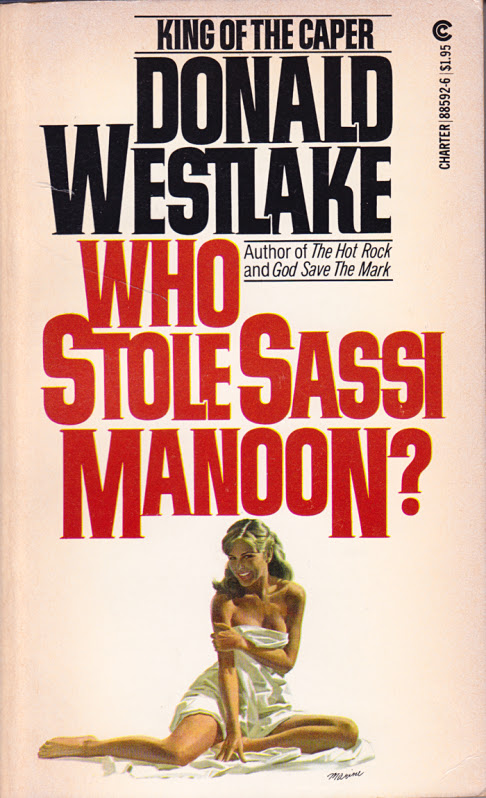
Books: Who Stole Sassi Manoon By Donald E. Westlake (1969)

“Who Stole Sassi Manoon? That was the question rocking Montego Bay Film Festival. You might ask Kelly Bram Nicholas IV, a twenty-five year old mad scientist and inventor of the sea-going computer STARNAP. Or Jigger Jackson, the girl who wants to be a movie star so badly she’d sell somebody else’s body. Or Major ffor-Linton and Miss Adelaide Rushby, who may or may not be English eccentrics. Or You might as Sassi herself –but she may not be able to tell you.” 

Apparently, this started out as a screenplay –which sort of explains some things. But when things fell through, Westlake adapted the screenplay into a novel and it doesn’t work, if only because Westlake is a novelist not who is not really deft at turning his own screenplay into a novel. Yes, he adapted Jim Thompson’s The Grifters into a brilliant, Oscar nominated screenplay and wrote a few others, but with Who Stole Sassi Manoon, this one may have not been a great screenplay to begin with, and so in prose, you see a lot of its weaknesses.

So certainly not the best Westlake caper, yet it has your typical Westlake set-up with some amateur, clueless, bumbling guys who want to kidnap and ransom off a movie star, and who generally think they have an air tight plan. Until things go wrong. The STARNAP machine –while never explained on how it works, why it works, -is interesting device, but I’m not sure Westlake thought this through (same with the island in the middle of the ocean they end up towards the end –not sure how and why it’s there and how it gets fresh water for the multiple bathrooms). Kelly, Robbie, and Frank are not violent (they could be early designs on Dortmunder and his crew which was a few years off when this book was released), and they can be funny and the set-up, while a bit long-ish, is actually good, but it’s betrayed by a convoluted ending.

Still, there are well-written passages in the book, with Westlake taking another swipe at the movie industry –despite needing their money. And there some ideas that will get revisited –and done better- in later books, but all told, a caper novel you could pass on from this prolific writer.

24 July 2021

Books: The Seven Husbands of Evelyn Hugo By Taylor Jenkins-Reid (2017)

“Aging and reclusive Hollywood movie icon Evelyn Hugo is finally ready to tell the truth about her glamorous and scandalous life. But when she chooses unknown magazine reporter Monique Grant for the job, no one is more astounded than Monique herself. Why her? Why now? Monique is not exactly on top of the world. Her husband has left her, and her professional life is going nowhere. Regardless of why Evelyn has selected her to write her biography, Monique is determined to use this opportunity to jumpstart her career. Summoned to Evelyn's luxurious apartment, Monique listens in fascination as the actress tells her story. From making her way to Los Angeles in the 1950s to her decision to leave show business in the '80s, and, of course, the seven husbands along the way, Evelyn unspools a tale of ruthless ambition, unexpected friendship, and a great forbidden love. Monique begins to feel a very real connection to the legendary star, but as Evelyn's story near its conclusion, it becomes clear that her life intersects with Monique's own in tragic and irreversible ways.”

Much of The Seven Husbands of Evelyn Hugo is a wild trip through Hollywood between the 1950s and well into the 1990s. While Hugo is obviously not a real person (and this somewhat an alternate universe of Hollywood), clearly author Taylor Jenkins-Reid based her movie star hero on other well-known historical movie stars such as Garbo, Tallulah Bankhead, Marilyn Monroe, Elizabeth Taylor, and Rita Hayworth. I also found a lot of similarities to Doris Day and her long-time relationship with Rock Hudson.

It’s not perfect and not particularly deep (though it does have a wonderful representation of bi characters that I’ve ever read), but the author did create a compelling book that made me want to turn the pages, to learn about her husband’s and other lovers. I found a lot of the “tabloid” articles particularly unbelievable –though the ones focusing on the 1950s and early 60s may be closer to accurate. The latter ones seemed more National Enquire than People –another words, the language and style changed and yet in this universe, it remains the same.

The twist that comes in the last 40 pages or so reminds of bad soap opera stunts, but I can overlook it because the book is pretty fun. And its themes of what some people do to reach the top in Hollywood, the risks, the loves won and lost, and dark secrets of what remains hidden to be a star are still relevant today.  

A worthy, fun beach read, that may have you staying longer at the beach than you wanted.

17 July 2021

Books: Declare By Tim Powers (2001)

As a young double agent infiltrating the Soviet spy network in Nazi-occupied Paris, Andrew Hale finds himself caught up in a secret, even more ruthless war. Two decades later, in 1963, he will be forced to confront again the nightmare that has haunted his adult life: a lethal unfinished operation code-named Declare. From the corridors of Whitehall to the Arabian desert, from postwar Berlin to the streets of Cold War Moscow, Hale's desperate quest draws him into international politics and gritty espionage tradecraft—and inexorably drives Hale, the fiery and beautiful Communist agent Elena Teresa Ceniza-Bendiga, and Kim Philby, mysterious traitor to the British cause, to a deadly confrontation on the high glaciers of Mount Ararat, in the very shadow of the fabulous and perilous Ark.

 I do have a problem with Powers style from time to time because he does use real life facts and places within his story and fits a supernatural one around it. This works a lot of the time, but here the book is caught in three speeds, slow, super slow, and then lightning fast. Regrettably, the book is overburden with so much minute detail of spying during WWII that I grew bored with it. In some ways, like John le Carré, that Powers insists on emulating, the history of spy’s and the final months of a world war are drawn with such detail, I felt I was reading a non-fiction book about spies. His cadence also seems old style, as he seemly is trying to emulate the way writers of the 1940s and early 1960s wrote. It gets distracting as well.

Huge portions of the text are given over to scenes of Andrew Hale involved in trying to keep his cover story clear, dealing with questionable people, with uncertain allegiances -which would look great on film or TV series, but it drags terribly in prose. It's slow, sometimes torturous and far too dense for its own good. A great deal of action happens, but the whole thing feels top-heavy: most of the good stuff is at the end, so you have to wade through a lot of extraneous material to get there. The underlying idea is fantastic, but by the time Powers got to the payoff, I had stopped caring.

As Tim Power says, ‘In a way, I arrived at the plot for this book by the same method that astronomers use in looking for a new planet—they look for “perturbations,” wobbles, in the orbits of planets they’re aware of, and they calculate mass and position of an unseen planet whose gravitational field could have caused the observed perturbations—and then they turn their telescopes on that part of the sky and search for a gleam. I looked at all the seemingly irrelevant “wobbles” in the lives of these people—Kim Philby, his father, T.E. Lawrence, Guy Burgess—and I made it an ironclad rule that I could not change or disregard any of the recorded facts, nor rearrange any days of the calendar—and then I tried to figure out what momentous but unrecorded fact could explain them all.’

29 June 2021

Books: The 7 1/2 Deaths of Evelyn Hardcastle By Stuart Turton (2018)


"Our narrator wakes up in a dripping forest, wearing someone else’s dinner jacket and, he soon realizes, someone else’s body. He has no memory of who he is or how he came to be trapped inside this stranger. Twigs crack behind him. A heavy object is dropped into his pocket and a voice rasps in his ear: “East.” Once alone, he pulls out the object; it’s a silver compass. Eventually our man learns that his name is Aiden Bishop, and he is here for a reason. A masked figure informs him tersely that today, a murder will be committed – a murder that won’t seem like a murder. Bishop has eight chances to solve it. He will relive the same day eight times, but each morning he’ll wake up in a different body, or “host”. He’ll remember his experiences in the previous hosts, but if he doesn’t give the masked figure the name of the killer by day eight, he’ll be returned to day one, memory wiped, and have to start all over again. As indeed he already has done, hundreds, perhaps thousands of times.”

I read a few reviews of this book and seemly, a lot of people are divided on it –either you’re going to accept the premise and get lost in the narrative, or you’re going to find everything a little bit hard to swallow. I was intrigued by the premise, that I’ll admit, the whole Groundhogs Day meets Downton Abby meets Agatha Christie meets Quantum Leap meets Doctor Who was a great hook, but I also found the a lot of things wrong with it as well. Part of the problem lay in writer Stuart Turton’s attempt to be clever, to create a locked room mystery, a whodunit that would make the reader want to turn the pages. I mean, it did, but mostly I was hoping for some explanation on how all of this happening. So the whodunit part gets buried under some weird stuff that renders it, oddly, sometimes secondary. Aiden Bishop is also an ineffective “detective,” sometimes coming across as a pathetic hero. But a lot of the characters at Blackheath Manor are paper thin caricatures, especially the footman who is so one dimensional it annoyed me.

The books’ setting seems weird. I know Turton was trying to emulate a lot Christie’s novel surroundings, the late 1920s or 30s, but since everyone in Blackheath Manor is either being blackmailed or doing the blackmail, you think this should’ve been set at some other time. Then there’s the fat shaming. Turton, in the Conversation with the Author at the end of book, claims he liked writing for Lord Cecil Ravencourt, but the during the part when Aiden has “replaced” goes on and on about how hugely overweight (I pictured the fat man from Monty Python’s Meaning of Life) the man is. Both Aiden and Ravencourt sees himself as a disgusting creature, a shameful man, that really borders on awfulness. Sometimes, it became unbearable to read. So because of this, Ravencourt is a lonely man, but rich one and who will enter into a marriage of convenience to help Peter Hardcastle, who is close to losing everything and seems more concerned with this, than the fate of his daughter. Then there is the part where Hardcastle implies Ravencourt to be a homosexual: “In return, he’ll get…Well, you know the rumors about his valets. Good-looking chaps coming and going at all hours.”

Not very pleasant. And completely pointless, as this does not figure anywhere else in the book.

Finally, Turton’s use of florid and theatrical prose gets maddening quickly. There seems to be no purpose to it (again, another aspect of the setting). All in all, an interesting idea that gets confusing fast and with a ton of twists and turns, a reader might want to have a handy pad of paper and pencil to try and untie the this complex plot. 

This book was originally released in the UK with the title The 7 Deaths of Evelyn Hardcastle in 2018. For it's US release it got The 7 1/2 Deaths of Evelyn Hardcastle, due to, it seems, to the popular Seven Husbands of Evelyn Hugo, which was released in 2017. 

23 June 2021

Books: Nature Girl By Carl Hiaasen (2006)


"Honey Santana—impassioned, willful, possibly bipolar, self-proclaimed ‘queen of lost causes’—has a scheme to help rid the world of irresponsibility, indifference, and dinnertime sales calls. She’s taking rude, gullible Relentless, Inc., telemarketer Boyd Shreave and his less-than-enthusiastic mistress, Eugenie—the fifteen-minute-famous girlfriend of a tabloid murderer—into the wilderness of Florida’s Ten Thousand Islands for a gentle lesson in civility. What she doesn’t know is that she’s being followed by her Honey-obsessed former employer, Piejack (whose mismatched fingers are proof that sexual harassment in the workplace is a bad idea). And he doesn’t know he’s being followed by Honey’s still-smitten former drug-running ex-husband, Perry, and their wise-and-protective-way-beyond-his-years twelve-year-old-son, Fry. And when they all pull up on Dismal Key, they don’t know they’re intruding on Sammy Tigertail, a half white–half Seminole failed alligator wrestler, trying like hell to be a hermit despite the Florida State coed who’s dying to be his hostage"

This is my first Carl Hiaasen book and his fifteen solo novel (after writing three mysteries with fellow journalist William Montalbano) overall. I knew Hiaasen did mostly humorous crime thrillers and mysteries, I knew he made fun of Florida and the weird people that populate the state, I know he’s an environmentalist and a unabashed liberal, but Nature Girl appears to be something different. It’s funny; it does contain elements of native history (a character that apparently appeared in his first solo novel, Tourist Season), but it's not what I expected. I think it’s more a parody, than laugh out loud funny thriller, but it does have a grotesque villain and good, but sometimes bad hero. So it is more light comedic fiction, I guess, versus what I’ve always read about his books dark themes (apparently, what I’ve read, his books follow a very basic structure, much like Richard Stark’s Parker series). So there is some violence -though, some of it surprising, if I may be honest. It’s not a bad book and probably won’t prevent me from reading his other books (I’ll find some of earlier titles and see where we go from there), but ultimately Nature Girl is bit too long and a bit uninteresting.

16 June 2021

Books: Slayground By Richard Stark (1971)

“The Wheel of Fortune turned and Parker figured his number had finally come up. An armored car heist had gone sour. His partners were dead or dying. He had escaped with the loot, but holing up in a deserted amusement park with only one exit had turned into a fatal mistake. Now the local mob and a couple of crooked cops were on their way in after the money...and the odds were against Parker getting out with his life. But Parker always did like to play the long shots. Besides, he knew all the ways there were to kill: with his gun...with his knife...with his own bare hands. So the hunter becomes prey. Outnumbered and outgunned, Parker realizes one miscalculation will end his career. So he’s low on bullets—but, as anyone who’s crossed his path knows, that definitely doesn’t mean he’s defenseless.”

Certainly not a great Parker novel, or one with an even probable plot, but as I read, its clear Stark/Westlake was doing his version of the Most Dangerous Game –TV shows and movies have been doing this variation of the tale, so why not Parker? There are a few things that bothered me, though, like whole idea of getting him trapped in an amusement park to begin with (with the local hoods commenting that this was a “locked-room mystery”), but if you are doing a variation on Richard Connell's short story, this can make sense? part of it seems dubious, that like no one around the park would miss all the action going on there –it is winter, the park is closed up, so when lights and music get turned on, won’t some investigate it? Then again, this town is corrupt, with dirty cops and a mob boss who gets around on a golf cart. Then there is Parker going all Home Alone, as he sets bobby traps for the hoods, which is doing something we’ve never had him do before. Also, did amusement parks in the late 60s or early 70s actually sell real hunting knives as a souvenir?

Interesting, the book ends with no resolution and I guess this tale with be revisited in the next book, or the one after it.

Slayground does show Parker is more human, insomuch as he gets injured and has deal with that; a nice touch. But Westlake also paints him as the cleverest man alive and those hoods, the mob boss, and the dirty cops are dumb as a box of hair. This was something he did in the Dortmunder novels as well. Surprisingly, there is little in the way of continuity references (the last book was full of them), but for longtime readers, we get a brief cameo appearance of Alan Grofield, who appeared in The Score and The Handle (and who by the time this book was published, had appeared in his own spin-off series). So in the end, this 14th volume in the series is definitely a stand-alone-tale.

There was a very loose British adaptation of Slayground done in 1983, which was directed by Terry Bedford. It starred Peter Coyote, Mel Smith, and Billie Whitelaw.