Showing posts with label carlos ruiz zafón. Show all posts

29 November 2018

Books: The Labyrinth of the Spirits by Carlos Ruiz Zafon (2018)


"Nine-year-old Alicia lost her parents during the Spanish Civil War when the Nacionales (the fascists) savagely bombed Barcelona in 1938. Twenty years later, she still carries the emotional and physical scars of that violent and terrifying time. Weary of her work as an investigator for Spain’s secret police in Madrid, a job she has held for more than a decade, the twenty-nine-year old plans to move on. At the insistence of her boss, Leandro Montalvo, she remains to solve one last case: the mysterious disappearance of Spain’s Minister of Culture, Mauricio Valls. With her partner, the intimidating policeman Juan Manuel Vargas, Alicia discovers a possible clue—a rare book by the author Victor Mataix hidden in Valls’ office in his Madrid mansion. Valls was the director of the notorious Montjuic Prison in Barcelona during World War II where several writers were imprisoned, including David Martín and Victor Mataix. Traveling to Barcelona on the trail of these writers, Alicia and Vargas meet with several booksellers, including Juan Sempere, who knew her parents. As Alicia and Vargas come closer to finding Valls, they uncover a tangled web of kidnappings and murders tied to the Franco regime, whose corruption is more widespread and horrifying than anyone imagined. Alicia’s courageous and uncompromising search for the truth puts her life in peril. Only with the help of a circle of devoted friends will she emerge from the dark labyrinths of Barcelona and its history into the light of the future."

While a satisfying, if over-long, finale to a quartet of books, The Labyrinth of the Spirits may be the weakest entry in Carlos Ruiz Zafon’s Cemetery of Forgotten Books series. While the prose remains strong, gorgeous even, the tale takes forever to get moving –to the point where I thought of giving up. The plot is complex, but not overtly intimidating, though out of the four books, this one should be read last (it was said that the books can be read in any order), as characters from the three previous books are all here. 

Much like other books, as well, we get a mystery, literary references, some bright and high humor, and a large body count. Alicia proves to be both a formidable creation, but can be irritating as well. She is clever, and sometimes that’s just because the plot requires her to be –same as the pain in her side happens when needed. But she is the anti-hero we’ve seen over the last few decades in TV and movies. 

These books, really, cling to the old-style way of telling a story, with much attention being paid to Spain itself as to the humans that occupy the country. A modern book, with old time charm.

17 February 2014

Books: The Prisoner of Heaven By Carlos Ruiz Zafón (2012)


“For Fermín Romero de Torres, who came back from among the dead and holds the key to the future 13.”

With those words written in the pages of Semperes & Sons copy of The Count of Monty Cristo, the mystery of Fermín Romero de Torres is about to begin. In the third book of Carlos Ruiz Zafón’s Cemetery of Forgotten Books series, the book is once more narrated by The Shadow of the Wind’s hero Daniel Sempere – now married to Bea and with a young child, and who is running the bookstore alongside his father.

It’s 1957 and business is not good and the two Semperes are struggling to make ends meet. Happiness is on the horizon though, as their close friend Fermín Romero de Torres is about to wed Bernarda, the love of his life. But there is something bothering Fermín and he is not his usual upbeat self. And when he learns of the visit of the mysterious man who left the note in the Dumas book, Fermín recounts to Daniel his involvement with David Martín, the man who was a dear friend of his late mother, Isabella, and who (might) be his actual father some 17 years earlier. The vast majority of this book is his account of his prison time at the infamous Montjuïc castle where during the days of Franco’s dictatorship (in the 40s), political prisoners where held and “disappeared”. The depiction of the prison and how the prisoners suffered was horrific and affecting. It is also here where de Torres encounters David Martín, who narrated The Angel’s Game

I’ve read a few reviews that criticize Ruiz Zafón of connecting all the characters together like this, that Fermín Romero de Torres (always the most enjoyable rouge) has been part of Daniel’s life forever. That it also brings into more questions about the unreliable narrator aspect of David Martín’s tale told in The Angel’s Game.  

I don’t know. Maybe I’ve been spoiled by reading too much, that I’m fine with Ruiz Zafón’s attempt at linking the narrative of this four-book series like he’s done. Some reviews say he cheapened the series by doing this (which calls into mind from me, how George Lucas tinkered with his Star Wars saga), but I think this may have been his intention all along. After all, you don’t write a quartet of tales set in the same universe –connected by Cemetery of Forgotten Books- and not interact with characters from the other books. Perhaps they were expecting something else? Still, I can understand some peoples criticism of this short, almost novella, type book. Perhaps when the author was outling this series, he saw a flaw and tried to course correct it with this book? Or maybe, in some pulpy way, this was his intention all along, that despite his love for literature, he is writing popular fiction that tends to live on the corner of Convenience and Consequence?

I do feel that Ruiz Zafón treatment of women is very old school annoying; they’re prostitutes with the heart of gold or beautiful women who must be pursued by other men, making their husbands jealous. The subplot about Daniel suspecting his wife of extramarital affair is dubious at best and really, it seems, designed to add another mystery for a concluding book.

Still, the writing remains captivating and Ruiz Zafón’s love of literature endures. If anything, a reader might be tempted to forgo the rest of this author’s tales and pick up the tomes of Alexandre Dumas, Dickens and Balzac and discover their own variation on a cemetery of forgotten books.

30 April 2012

Shadow of the Wind by Carlos Ruiz Zafón (2001)


The Shadow of the Wind is the first book in Carlos Ruiz Zafón loose tetralogy Barcelona Cycle, but is set before the second book, The Angel's Game. It’s a thriller (but not in the real sense of the word) about books and the mysteries that they sometimes create. Daniel Sempere is 10 years-old when he is led by his father into the back streets of Barcelona where  the Cemetery of Lost Books - a mausoleum for out-of-print works, salvaged by the bibliophiles of the city- lies. Sempere discovers a book called The Shadow of the Wind, by Julián Carax, which captures his young imagination. But when he investigates this unknown author, he finds out that his is the last surviving copy, as a mysterious figure called Laín Coubert has dedicated himself to eradicating Carax's work completely. But in Carax's book, Laín Coubert is the name of the Devil..

It’s a slow thriller, but still interesting as we get a detailed history of Spain and its people. Still, while the prose is great, the voice strong, on the whole the book never seems to ably payoff its premise. Ruiz Zafrón creates a book with multiple genres wedged in –vaguely thriller like, with supernatural aspects, a love story, a coming of age tale. Then there is the dues ex machine ending that sort of halts the book completely –so much so, it reminded me of The Girl with Dragon Tattoo’s misbegotten ending that almost made me not want to continue.. 

Still, the novel is moody, appealing and thoroughly readable, but ultimately lacks the magic its early chapters promised.The third book of the series, Prisoner of Heaven, will be released on July 10.

06 March 2012

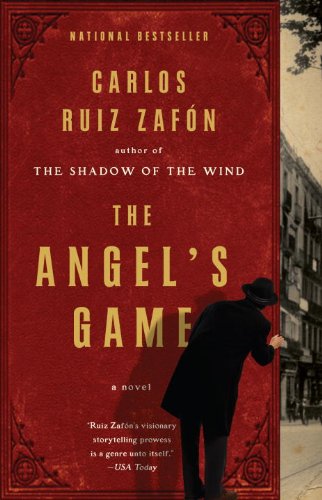
Books: The Angel's Game by Carlos Ruiz Zafón (2009)


Books are to me what music, gaming, cooking, sports and other activities are to others. I love them, like I love my family. Nothing makes me feel happier than the smell, the texture, the elegance of a book. And my primary genre is fiction. I think one of the reason I like Stephen King so much is that there is always a writer in his tales. In some ways, it goes back to the notion for all writers struggling to fill up blank papers with a bunch of letters to create sentences, paragraphs that create a story from nothing, write what you know. 

And writers, who write about books, where the central theme of the story is about a book, or books, are always endlessly fascinating for me. I have always been aware of Spanish author Carlos Ruiz Zafón’s 2001 best-seller The Shadow of the Wind. It sounded like an intriguing novel, but to this day, I’ve never bought to add to my ever increasing collection of books. Plus, I will admit, I’ve never been fond of the first person narrative, and that will sometimes hinder my judgment on authors I’ve never read before. 

The Angel’s Game, the prequel to 2001 novel came out in 2009. We received a copy of the book at my late Borders store when it came out in paper in 2010. Never –usually- to pass up a free ARC, I took it home and it has sat here for close to 2 years. 

Since being unemployed and sort of given up on finding a job, I can’t buy books. But since I have probably 60 or more books not read sitting in boxes, this has become a perfect time to catch up before I become homeless or, more logically, end my life.

Now seeing this is a prequel –and set sometime before the first book- I felt pretty secure that I would not have worry too much. Then I went online and discovered that Ruiz Zafón was creating a four book series set in Barcelona in the early decades of the 20th Century, and while they would share the same universe, same locations like the Cemetery of Forgotten Books, they could be read separately, and in any order.  

In The Angel’s Game we meet a young, tortured writer named David MartÍn, who after struggling for years writing pulp fiction for unscrupulous magazine publishers, and who also lives in the shadow of a more popular, but less creative, fellow author, is offered a lucrative commission from a mysterious editor from Paris. This well-dressed man represents something called Éditions de la Lumière (Editions of the Light), and soon David suspects he may have made a deal with the devil.

Within this novel, Ruiz Zafón takes the slenderest of ideas –what artist has not thought about selling their soul for success- and creates a wonderful, pulpy, melodramatic tale that zigs and zags through the streets of Barcelona like a toy car out control. 

It’s a fairly literary novel, wrought with history lessons, lost loves and damaged souls. Only towards the end, where bodies start piling up like a some 20th Century version of George RR Martin’s Game of Thrones series, does the story unwind. Still, now that I’ve read this one, I’ll figure out how to get my hands on The Shadow of the Wind (if I can’t find it in a used bookstore, I may end up ordering a used version on Albris). The third book in this Barcelona cycle, The Prisoner of Heaven, is due in June.