Books are to me what music, gaming, cooking, sports and
other activities are to others. I love them, like I love my family. Nothing
makes me feel happier than the smell, the texture, the elegance of a book. And
my primary genre is fiction. I think one of the reason I like Stephen King so
much is that there is always a writer in his tales. In some ways, it goes back
to the notion for all writers struggling to fill up blank papers with a bunch
of letters to create sentences, paragraphs that create a story from nothing,
write what you know.
And writers, who write about books, where the central theme
of the story is about a book, or books, are always endlessly fascinating for
me. I have always been aware of Spanish author Carlos Ruiz Zafón’s
2001 best-seller The Shadow of the Wind.
It sounded like an intriguing novel, but to this day, I’ve never bought to add
to my ever increasing collection of books. Plus, I will admit, I’ve never been
fond of the first person narrative, and that will sometimes hinder my judgment
on authors I’ve never read before.
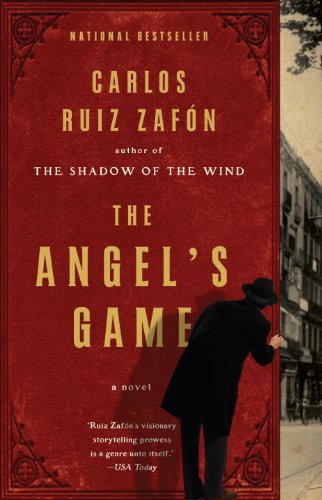
The Angel’s Game,
the prequel to 2001 novel came out in 2009. We received a copy of the book at
my late Borders store when it came out in paper in 2010. Never –usually- to
pass up a free ARC, I took it home and it has sat here for close to 2 years.
Since being unemployed and sort of given up on finding a
job, I can’t buy books. But since I have probably 60 or more books not read
sitting in boxes, this has become a perfect time to catch up before I become
homeless or, more logically, end my life.
Now seeing this is a prequel –and set sometime before the
first book- I felt pretty secure that I would not have worry too much. Then I
went online and discovered that Ruiz Zafón was creating a four book series set
in Barcelona in the early decades of the 20th Century, and while
they would share the same universe, same locations like the Cemetery of
Forgotten Books, they could be read separately, and in any order.
In The Angel’s Game
we meet a young, tortured writer named David MartÍn, who after struggling for
years writing pulp fiction for unscrupulous magazine publishers, and who also lives
in the shadow of a more popular, but less creative, fellow author, is offered a
lucrative commission from a mysterious editor from Paris. This well-dressed man represents something called Éditions de la Lumière (Editions of the Light),
and soon David suspects he may have made a deal with the devil.
Within this novel, Ruiz Zafón takes the slenderest of ideas –what
artist has not thought about selling their soul for success- and creates a wonderful,
pulpy, melodramatic tale that zigs and zags through the streets of Barcelona like
a toy car out control.
It’s a fairly literary novel, wrought with history lessons,
lost loves and damaged souls. Only towards the end, where bodies start piling
up like a some 20th Century version of George RR Martin’s Game of Thrones series, does the story
unwind. Still, now that I’ve read this one, I’ll figure out how to get my hands
on The Shadow of the Wind (if I can’t find it in a used bookstore, I may end up
ordering a used version on Albris). The third book in this Barcelona cycle, The Prisoner of Heaven, is due in June.