Showing posts with label agatha christie. Show all posts

28 December 2025

Books: Endless Night By Agatha Christie (1967)

“Gipsy’s Acre was a truly beautiful upland site with views out to sea – and in Michael Rogers it stirred a child-like fantasy. There, amongst the dark fir trees, he planned to build a house, find a girl and live happily ever after. Yet, as he left the village, a shadow of menace hung over the land. For this was the place where accidents happened. Perhaps Michael should have heeded the locals’ warnings: ‘There’s no luck for them as meddles with Gipsy’s Acre.’ Michael Rogers is a man who is about to learn the true meaning of the old saying ‘In my end is my beginning.’” 

Endless Night is an interesting fun, briskly paced thriller, and despite being well into her late 70s at the time, Christie captures the voice of a young twenty-something narrator (and his many layers). Narrated by Rogers (who becomes more amoral and deeply layered as the tale progresses), the book works primarily, I think, because it stays focused on the two main characters. This is not her traditional cozy mystery/whodunit she was well known for, so I can see why the reviews in 1967 questioned her departure from the norm. 

Perhaps, also, because this tale is really focused on two main characters, they are given more depth and dimension than her typical crime thrillers with multiple folks. While Fenella (Ellie) Guteman comes across as typical character Christie does create (the super rich heiress) she is still somewhat three dimensional Still, any hardcore Christie fan will note there are some patented aspects she’s added, including the sometimes Gothic atmosphere that ran through her earlier work, and the cursed land (which adds a bit of potential superstitions to the book). I have to admit that despite some of those aspects, I was caught off guard by many things that I should’ve seen earlier. 

While I spent my early youth and teen years reading her novels, it’s been a decade or more since I read her regularly (I did read Halloween Party back in 2022 and 4.50 From Paddington in 2020, as well as Death in the Clouds that same year). I gave her up about the time I really got into fantasy novels in my late teens and early twenties. So maybe I’ve forgotten what a brilliant writer she truly was, how layered she can be. While her books were sometimes wildly uneven at times, she was still writing popular fiction and adding a lot of social commentary on British society, poking fun at it, and dealing with dark subjects that appealed to her and, hopefully, her broader audience. And her, it is written, she wrote this book in a flurry of about six weeks, while her other books generally took about three to four months to complete. And you can tell, as the prose moves the book swiftly away. 

I can also see why this book has been adapted several times, as it seems prime for TV or a movie; that includes a British ITV version that adds Miss Marple in 2013, a French TV version in 2021, a new TV version coming from BBC and Britbox International for 2026 and new theatrical version being planned for 2027. 

Mostly though, Endless Night works really well. It has eeriness to it and offers a splendid twist which then makes thing earlier book become more obvious. 

The title is a reference to William Blake's "Auguries of Innocence”: 

"Every night and every morn,
Some to misery are born,
Every morn and every night,
Some are born to sweet delight.
Some are born to sweet delight,
Some are born to endless night."

25 October 2022

Books: Halloween Party By Agatha Christie (1969)

“At a Hallowe’en party, Joyce – a hostile thirteen-year-old – boasts that she once witnessed a murder. When no-one believes her, she storms off home. But within hours her body is found, still in the house, drowned in an apple-bobbing tub. That night, Hercule Poirot is called in to find the ‘evil presence’. But first he must establish whether he is looking for a murderer or a double-murderer. Unmasking a murderer isn't going to be easy for Poirot. But with his friend, crime novelist Ariadne Oliver,  they investigate reckless teenagers and take on occult themes. Again, the sharp wits of Poirot and the enthusiastic deduction of Mrs Oliver join forces.”

Not a particularly exciting whodunit, but it does have the usual Christie flair of sometimes witty, sometimes mean characters. And it’s her only book where a child is murdered. The novel, though, is seemly concerned with how times have changed since Ms. Christie’s first book was released in 1920. Published 1969, near the end of her life, Halloween Party has many characters commenting on the how society has really changed in those last fifty years. There are a lot of discussions about how the criminal justice system has changed, which was probably a not so veiled reference to abolition of capital punishment in 1965 in the UK. But all the older characters seem a bit bitter that youths are taking over and disrespecting their elders and getting away with major crimes because they come from broken homes. Also, it seems, in her old age, Christie appears somewhat taken aback about how the world changed in the 1960s –the more permissiveness of any era she lived in.

The book lags and comes off more simple and less complex than her previous works –almost (maybe) like she needed a book to fulfill a contract. Still, she would publish three more novels, 1971s Nemesis, her last written featuring Miss Marple, 1972s Elephants Can Remember, the last novel she wrote featuring Hercule Poirot, and 1973s Postern of Fate, the last featuring her other recurring detectives, Tommy and Tuppence Beresford. However, there were two more books featuring Poirot and Miss Marple to come. Christie, fearing she be killed during WWII, decide to write two novels that would be published after her death. So during the height of this terrible period in the 1940s, she wrote Curtain (1975), the “official” last Hercule Poirot mystery and Sleeping Murder (1976), the “official” last Miss Marple mystery. They would sit in a vault for the next three decades. But in the span of those thirty-odd years, she never went back and revised them, so they’re somewhat set outside of her established continuity of both those characters.

Indecently, actor/director Kenneth Branagh will helm and star in an adaptation of this book set for the fall of 2023. What changes will be made to the story should be interesting. The two remakes Branagh did, Murder on the Orient Express and Death on the Nile were both set in 1934 and 1937, respectively. A Haunting in Venice, the title of this new film, will probably have to be set in the same time period. So I’m guessing all the “social commentary” of the late 1960s will be excised.

12 April 2022

Books: Death in the Clouds By Agatha Christie (1935)

“From seat No.9, Hercule Poirot was ideally placed to observe his fellow air passengers. Over to his right sat a pretty young woman, clearly infatuated with the man opposite; ahead, in seat No.13, sat a Countess with a poorly-concealed cocaine habit; across the gangway in seat No.8, a detective writer was being troubled by an aggressive wasp. What Poirot did not yet realize was that behind him, in seat No.2, sat the slumped, lifeless body of a woman.” 


When I read a lot of Agatha Christie tales in the latter half of the 70’s, the editions I read were the ones released by Berkley Books, an imprint of Penguin Books. At the time, I don’t think I caught onto some of the subtleties of her social commentaries going on throughout the books. I mean, there is a scene at the Inquest, were all the potential killers are giving their views, with reporters listening on. She makes it very obvious that reporters see things in sensational views. Not only do they make headlines in their heads about the murder, how sensational it is, and how it was done, but when it came to describing the women’s POV, especially the ones from high society, the reporters are more concerned with communicating their fashion than their take on what happened on the plane. Christie was a feminist, so I think this is a jab at the tabloids of the time, where any women of high society being caught up in a murder investigation has to take a backseat to looks and their stations in England during this period (though nearly 90 years later, this continues in the press). As a matter of fact, even a few male characters voice the same thing that being caught up in this unsavory murder is detrimental to their public appearance, both in their work and private lives.

I also found it interesting the changes Berkley Books made to some of the prose. In the UK version of the paperback, which was released by Fontana Books (a division of Harper Collins) in 1935, they kept the word “bitch” in when describing a person, but Berkley changed it to “hag” in the American edition. Also the word “toilet” was changed to “bath room.” There are also some “meta” moments in the book, along with other doses of social commentary, like when Inspector Japp reflects on mystery writers who spend their time researching death: “I don’t think it’s healthy for a man to be always brooding over crime and detective stories, reading up all sorts of cases. It puts ideas into his head.” Christie was well known for doing a lot of research for her novels, but she was also a woman who was making a fortune writing these whodunits.

Death in the Clouds (AKA as Death in the Air) is set in 1935, and it’s interesting to note the use of psychology of the crime, which was in its infancy then. It’s sort of made fun here by the police, but Poirot seems to subscribe to it. That’s why so much is made of the boldness of the crime, how it was committed in such an enclosed environment and how it must’ve been witnessed by many people who didn’t realize it or unaware they were seeing a murder. When he talks to the maid of the dead woman (a women of “lower class”, I guess?), she seems unwilling to reveal much to a police, who know how to manipulate those servants (seemly something that remains consistent today, some 90 years ago later), Poirot, as a private detective, tells her (in another meta moment, as this is a plot device of all murder mysteries seemly have) that “In every a case of a criminal nature ones comes across the same phenomena when questioning witnesses. Everybody keeps something back. Sometimes –often indeed- it is something quite harmless, something, perhaps quite unconnected with the crime; but –I say it again- there is always something.”

I did look up the Irish Sweep –the character of Jane Grey’s Paris trip was funded by this. I had never heard of it, so was curious if it was a real thing. It was: The Irish Free State Hospitals’ Sweepstakes, was a lottery established in 1930 to fund Irish hospitals. Lotteries of any kind were illegal in the UK at the time and by 1934, an act prohibition on the import and export of lottery related materials was enacted. But it didn’t stop some English from taking advantage of it.

There are a few racist moments within the book, as well, including the word “Ikey”, which was slang to refer to Jane’s Jewish boss. Also, Norman and Jane also discover their mutual dislike for “negroes”. The French also come under fire, with Jane thinking to herself “he’s French, though. You’ve got to look out with the French, they always say so.” Even Poirot gets insulted: “Foreigners, you can’t trust foreigners, even if they are hand in glove with the police”. It all seems unseemly, tacky and okay. One can see why in later editions of these books and others, some of this stuff is toned down, I guess. It’s like what happened to the original Nancy Drew titles published in the 1930’s. By the 1950’s a lot racist passages those books contained were completely re-written or certain some passages were dropped from those books and then re-issued to American’s who’s views had changed since WWII.

It’s a fun read, maybe not as brilliant as say Death on the Nile or Murder on the Orient Express, but its still a great whodunit.

12 December 2020

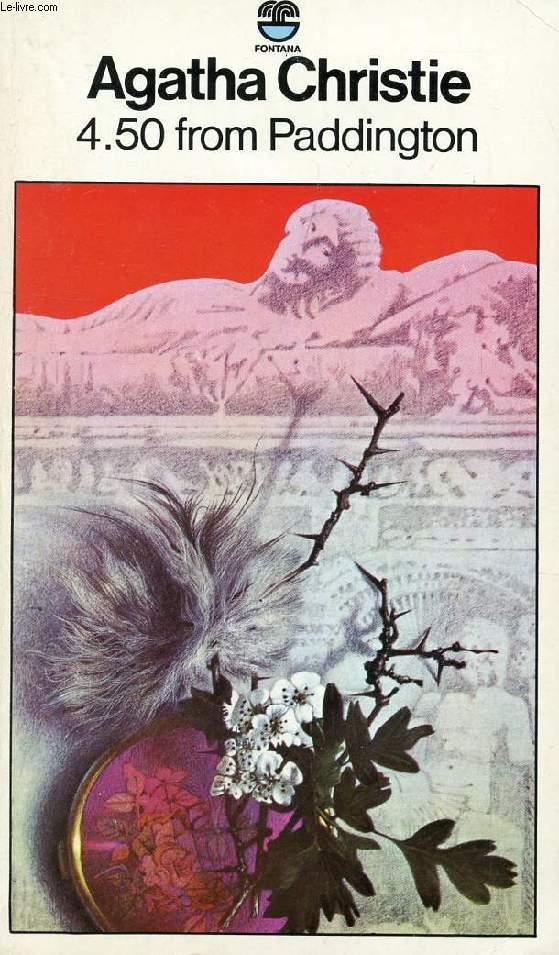
Books: 4.50 From Paddington By Agatha Christie (1957)

 9780006157625 - AbeBooks

“For an instant the two trains ran together, side by side. In that frozen moment, Elspeth witnessed a murder. Helplessly, she stared out of her carriage window as a man remorselessly tightened his grip around a woman’s throat. The body crumpled. Then the other train drew away. But who, apart from Miss Marple, would take her story seriously? After all, there were no suspects, no other witnesses... and no corpse.”

When I was much younger –my first year of High School- I found reading Agatha Christie novels the best time waster. I liked her books, liked her prose, even if I generally found the whodunits a bit difficult to solve. She was, in many ways, able to keep readers interested even when she sometimes pulled a last minute switch on the reader who felt they had solved the crime. Over about a year, I read too many of her tales, eventually moving onto the genre of fantasy and sci-fi. But I’ve always wanted to return to the writer, but have generally never found the time. The modern Doctor Who episode The Unicorn and The Wasp made me want to read her again, but that episode aired twelve years ago, so I guess I was in hurry to read another book by Ms. Christie.

Still, 4.50 From Paddington (published in the US as What Mrs. McGillicuddy Saw!) is the seventh novel to feature Miss Marple, but interestingly enough, she is sort of peripheral to story. Why this was done is odd. Jane Marple was often characterized as an elderly spinster, someone in her 70s, but seemly her energy varies from story to story. Here she seems somewhat frail, playing Nero Wolf, to Lucy Eyelesbarrow, a skilled cook and energetic housekeeper with a good reputation and excellent client list, who is very independent woman. I loved her and she ends up, actually, being the best thing about the book.

As always, Ms. Christie gives us another glimpse into the negative side of human nature. Part of her charm is how well she does this, how all the characters are caricatures, yet all have more dimension to them than you might expect. I liked the book, like the plotting, even the mystery was interesting, but I found myself still wishing Miss Marple was more central to the tale –even if Eyelesbarrow proved a fair proxy.